



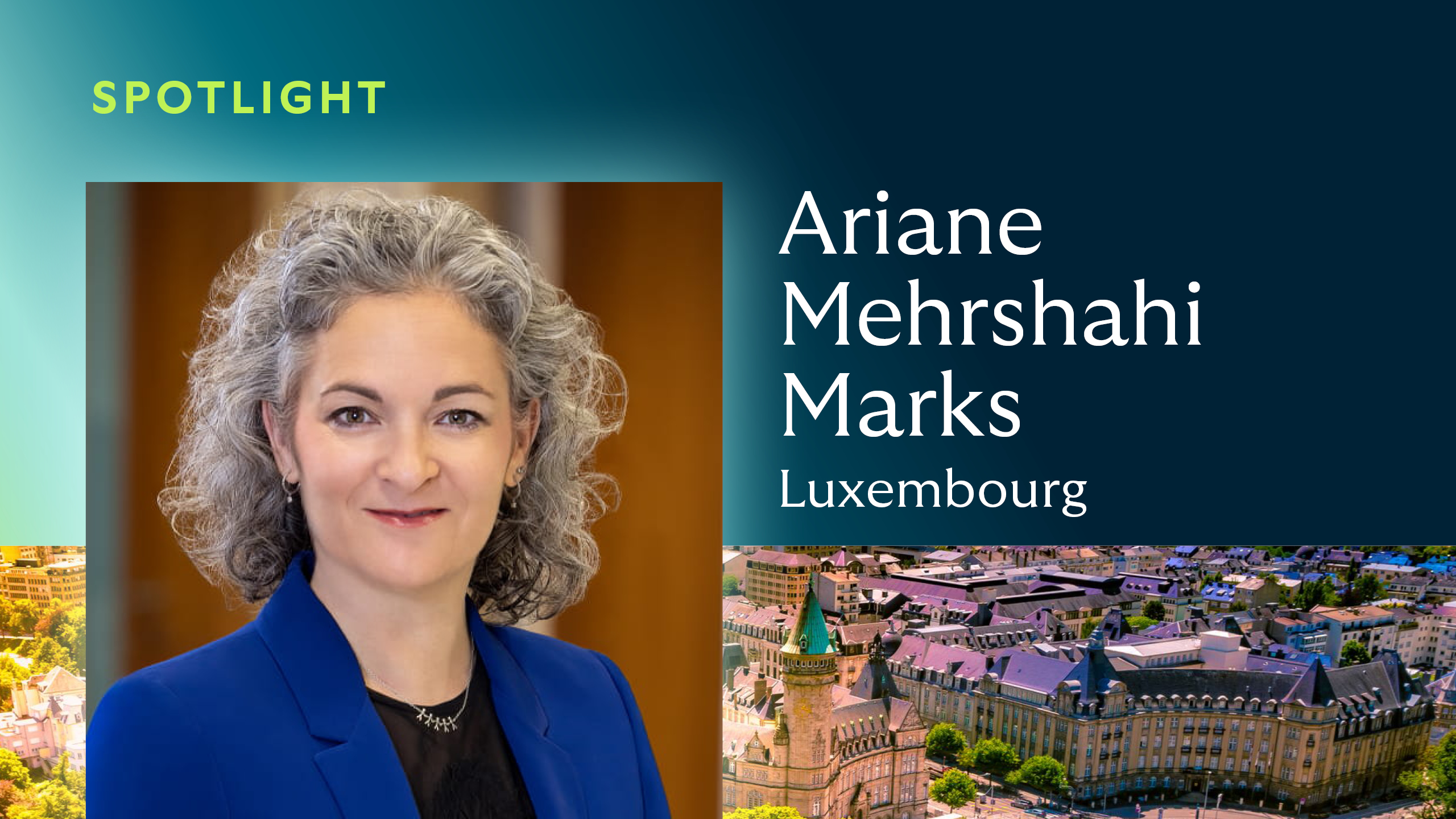
Welcome to this week's Spotlight, where we have the pleasure of introducing you to Ariane Mehrshahi Marks, a partner in our Luxembourg office with nearly 20 years' experience in the Luxembourg finance sector. Ariane heads the firm’s capital markets and finance practice in Luxembourg. Her practice covers various types of loan financing, refinancing, and restructuring, including fund finance.
Let's learn a bit more about Ariane, her practice, and the Luxembourg market.
What first attracted you to fund finance, and how has your career evolved during your time at the firm?
What initially attracted me to fund finance was the intersection of several areas of finance that I have always enjoyed working on: loan finance, capital markets and structured finance deals, as well as on regulatory and securitisation aspects, including in the wider private capital ecosystem. Fund finance transactions are rarely one-dimensional; they require an understanding of fund structures, investor dynamics, financing arrangements and the commercial objectives of all stakeholders. That combination makes the work intellectually stimulating and highly collaborative, including across different practices. The market has also evolved significantly over the years, creating opportunities to work on increasingly sophisticated and innovative financing solutions.
My practice has always been far more extensive than fund finance. Throughout my career, I have advised on a wide range of loan finance, restructuring matters and capital markets transactions, including securitisation, real estate, acquisition, leveraged, asset and trade finance, and venture capital deals. Working across these areas has given me a broader perspective on how different financing products interact and has been particularly valuable when advising clients on complex cross-border transactions with a Luxembourg nexus.
My career at the firm has evolved alongside the growth of our Luxembourg practice. I was part of the team that established the Luxembourg office in 2013, and over the years I have had the opportunity to develop our finance and capital markets offering while working with clients across a wide range of industries as on regulatory and securitisation aspects, including in the wider private capital ecosystem.
Fund finance transactions are rarely one-dimensional; they require an understanding of fund structures, investor dynamics, financing arrangements and the commercial objectives of all stakeholders. That combination makes the work intellectually stimulating and highly collaborative, including across different practices.
How would you characterize the current state of the fund finance market in your primary practice area—and what notable trends are you observing?
The fund finance market has evolved significantly over the years, creating opportunities to work on increasingly sophisticated and innovative financing solutions.
One of the most notable trends is the continued growth of NAV-based financing. While subscription facilities remain a core liquidity management tool for funds, we are seeing increasing interest in financing solutions secured by portfolio assets, particularly as sponsors look for greater flexibility in managing liquidity, supporting portfolio companies, funding follow-on investments and facilitating continuation fund transactions. NAV financing has become a much more mainstream product across a broader range of asset classes and fund strategies.
We are also seeing growing interest in financing solutions linked to blended finance platforms and impact-focused investment strategies. As public institutions, development finance institutions and private capital providers increasingly collaborate to channel investment towards infrastructure, climate transition and sustainable development projects, financing arrangements are becoming more sophisticated.
More broadly, I think we are seeing fund finance become an increasingly strategic tool throughout the life cycle of a fund. As private capital structures continue to evolve, I expect innovation in fund finance products to remain a defining feature of the market, with Luxembourg continuing to play a central role in that development given the strength of Luxembourg’s fund industry.
Based on current trends and recent shifts in your practice, where do you see the most potential for growth in fund finance over the next few years, and what forces will drive that growth?
I see significant growth potential in fund finance at the intersection of private capital, structured finance and capital markets. As funds hold assets for longer and seek greater flexibility, demand for NAV-based financing, hybrid facilities and other tailored liquidity solutions is likely to continue increasing. I also expect blended finance to play a growing role, as public and private capital are combined to fund infrastructure, energy transition and impact-focused investments at scale. At the same time, advances in tokenisation and digital assets have the potential to transform how assets are financed, distributed and managed, with Luxembourg well positioned to support these developments through its strong legal and regulatory framework.
What can you tell us about the state of fund finance in Luxembourg?
From a Luxembourg perspective, the fund finance market remains very active and continues to evolve alongside the growth of the private capital industry.
The Luxembourg fund finance market remains highly active and increasingly sophisticated. Given the breadth of investment funds and asset managers operating through Luxembourg structures, the jurisdiction continues to see a wide range of financing solutions across the fund lifecycle. In addition, the tokenisation of fund units will drive the future of the jurisdiction.
Luxembourg is naturally at the heart of many of these developments because most international fund structures are established here. As a result, we intervene at the fund level and asset level, as well as in the establishment of various collaterals. The transactions often involve multiple jurisdictions, asset classes and stakeholder groups, making fund finance an increasingly sophisticated and international practice area.
Overall, the market is characterised by strong demand, continued product innovation, tokenisation of fund units just as an example, and increasing integration with the wider private capital ecosystem.
What are your capabilities in your region?
My team of six people has various loan financing, and IDCM backgrounds, including experience in fund finance. We also cover restructuring matters, various types of loan finance, on the creation of collateral over all types of assets, as well as in capital markets matters such as equity and debt issuance, securitisation transactions with regulated as well as non-regulated securitisation vehicles, listing matters and various regulatory aspects of capital market transactions.
The office also covers areas that interact closely with the finance practice, such as Fund formation, Tax, Corporate (M&A/Private Equity) and Regulatory.
Who are other colleagues in the Luxembourg office to know?
Our Office Managing Partner, Pierre Reuter, who heads the Investment funds and Regulatory practice, as well as Gérard Neiens and Alexander Koch, leading Tax and Corporate practices respectively, are colleagues with whom I work closely.
We mainly work on cross-border matters in close collaboration with most Hogan Lovells Cadwalader offices.
What are some noteworthy deals you’ve been involved with over the past year?
On the fund finance side, for example, we collaborated with Bryony Widdup and Amelia Stawpert in London on Camco Management Limited in the widely publicized launch of Camco REPP 2, a cutting-edge blended finance fund domiciled in Luxembourg, with a targeted fund size of US$250m, in which GCF is a cornerstone investor.
We are also on the panel of the European Investment Bank and work regularly on their financings.
Another good example of cross border collaboration in this case with German colleagues is the securitisation of solar and heat pump receivables for Enpal, market leader for photovoltaic systems in Europe. The firm has been named Esoteric ABS Law Firm of the Year and ESG Law Firm of the Year at the GlobalCapital European Securitization Awards 2026 – he second consecutive year that Hogan Lovells Cadwalader Germany has won both titles, thanks to this transaction.