




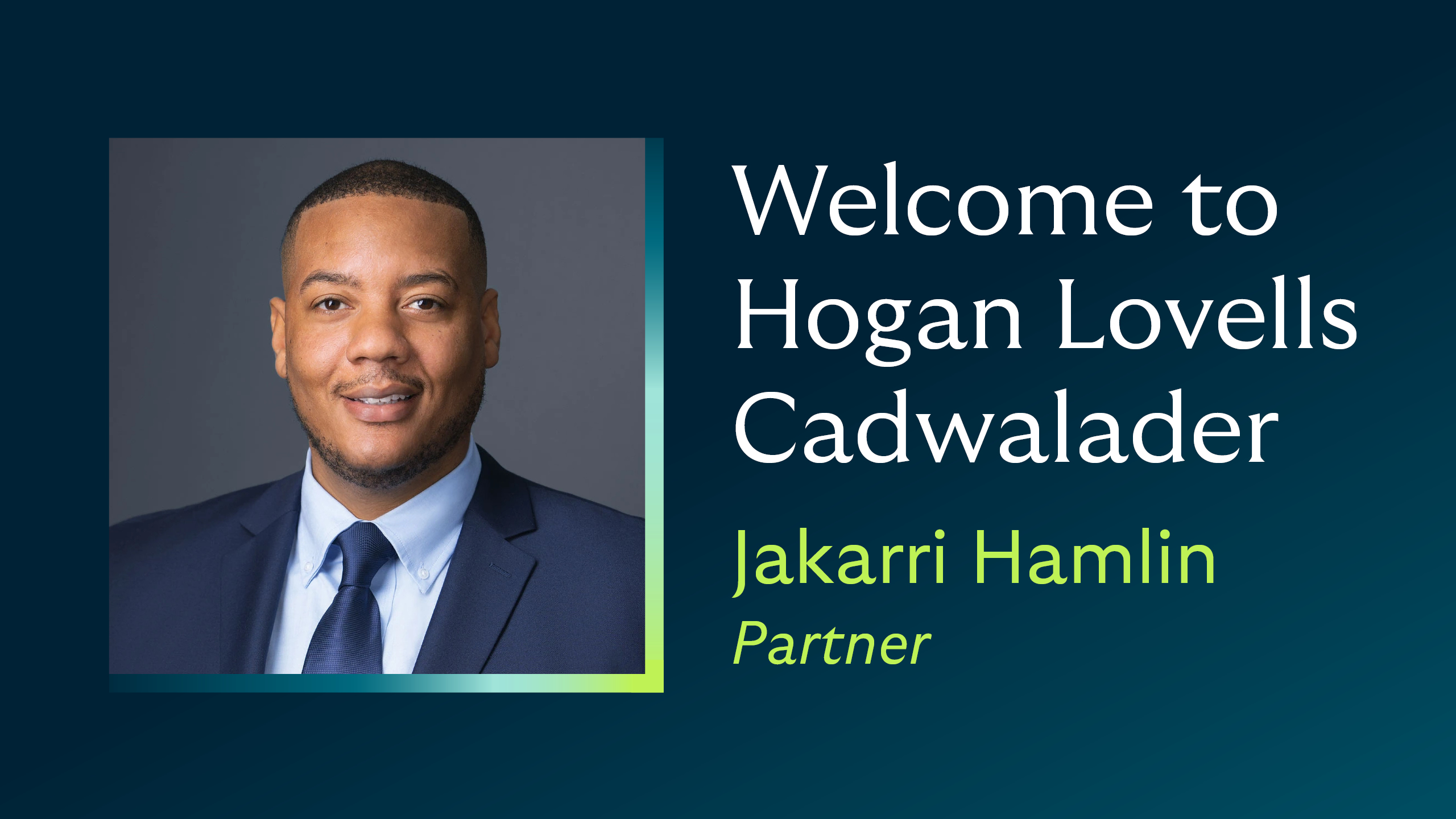
This week, Jakarri Hamlin joined Hogan Lovells Cadwalader as a partner in our Los Angeles office.
I'm thrilled to welcome Jakarri back to the firm as he began his legal career as a Cadwalader associate. Many of us from legacy Cadwalader have had the privilege of working with and knowing him for a decade, and he's a valuable addition to the continued expansion of our Fund Finance platform and also our growing transactional practice in Los Angeles.
Jakarri's practice focuses on fund finance. He advises financial institutions as well as asset managers across all asset classes in financings such as NAV, hybrid, and subscription facilities, structured and asset-backed financings, holdco loans, mezzanine loans, margin loans, and other forms of back leverage.
He has substantial experience structuring and negotiating ISDA documentation, as well as prime brokerage, repurchase, and other trading agreements; he began his career in structured finance and derivatives before shifting into fund finance, giving him unusual range across the financing stack.
Jakarri joins the firm after we welcomed Bob Hayes as a partner in Los Angeles earlier this summer, and we're committed to adding lawyers across our global platform who, like Jakarri and Bob, can help our clients achieve their business goals.
You can read the press release announcing Jakarri's appointment. Now, let's get to know a bit more about him and his practice.
Q&A with Jakarri Hamlin
As a Cadwalader alumnus who began your career at the firm, what motivated you to join Hogan Lovells Cadwalader?
Joining Hogan Lovells Cadwalader felt like coming home. I started my career at Cadwalader, Wickersham & Taft LLP, and even as I moved through other parts of my career, I always measured other places against what I experienced at Cadwalader. There's a camaraderie here that's hard to find anywhere else. It's the sense that you're not just an employee, but genuinely part of a group invested in your success.
When the opportunity came to join Hogan Lovells Cadwalader, it wasn't a hard decision. This isn't just a new job for me. It's a return to a community I've been chasing ever since I left.
What first attracted you to fund finance, and how has your career evolved?
I always knew I wanted to be involved in private equity finance in some capacity. What drew me in initially was the structure of PE itself, how funds are built, how capital moves through them, and the ripple effects that has on the underlying companies and their operations.
Over the course of my career, I've had the chance to represent fund borrowers, lenders, investors and operating companies. This perspective has been invaluable. It lets me anticipate issues from several perspectives and address client needs more completely, which matters more than ever as the roles continue to shift and blur in this market.
What can you tell us about your practice and the clients you serve?
My practice is full service. I represent financial institutions and asset managers across the full range of asset classes on financings including NAV facilities, hybrid and subscription facilities, structured and asset backed financings, margin loans, as well as other forms of back leverage.
I also have substantial experience structuring and negotiating trading agreements. My client base spans both domestic and foreign market participants, which gives me a broad view of how different markets approach fund finance structures.
How would you characterize the current state of the fund finance market in your primary practice area, and what notable trends are you observing?
Fund finance is an ever-evolving space right now. It's busy, and being a part of it is genuinely interesting.
One trend I'm watching closely is how concepts from other areas of financing are starting to migrate into fund finance structures. Lenders, sponsors, asset managers, and investors are all experimenting with different products in different ways, which is creating a lot of innovation but also a lot of complexity. Staying ahead of that evolution, and helping clients navigate it, is where a lot of the interesting work is happening right now.
In which markets do you see the most potential for growth in fund finance over the next few years, and what forces will drive that growth?
I think we're going to see significant growth on the West Coast, and in California specifically, as more financing providers, fund sponsors and asset managers establish or expand their presence here.
Most notably, the driving force for expansion seems to be flexibility. Investors want structures that can adapt as market conditions shift rather than static financing arrangements, and that appetite is only growing. I expect we'll keep seeing lenders build more customizable, hybrid products that can flex across a fund's lifecycle, and that flexibility, more than any single geography, is what's going to define where and how the growth happens.