








Why the Irish Section 110 DAC is the Natural Issuer
Rated note feeders (RNFs) and collateralised fund obligations (CFOs) are investment and funding structures which are used to raise and deploy financing into private capital funds. These structures are already well established in the US and are now increasingly popular in Europe too. They offer investors, often but not only insurance investors, an alternative route for gaining exposure to private capital funds. This route is via rated debt securities and is intended to be more capital-efficient than gaining a similar exposure through an equity interest in the same fund. This opens up a wider pool of investors and capital for the fund managers managing these funds.
What You Need to Know
- A growing market heads for Europe: RNFs and CFOs are well established in the US. The aim is to give investors, who are often but not solely insurance investors, an alternative method of gaining exposure to private capital funds. Under an RNF/CFO structure, the exposure is via rated debt securities. This is intended to be more capital-efficient than gaining a similar exposure through an equity interest in the same fund. With record issuance and rising demand, managers are now looking to European investors.
- Ireland is the natural jurisdiction for an EU issuer: Ireland is already a leading European jurisdiction for establishing debt issuance SPVs for structured finance and securitisation transactions. Ireland’s s110 DAC is globally recognised and trusted in this context. It is complemented by Ireland’s jurisdictional attributes, which include legal and fiscal certainty, experienced and predictable courts, Anglo-American business culture, and a highly developed eco-system of professional advisors. This makes it a Tier 1 issuer location for CFOs and RNFs.
- Regulatory analysis is key: There are several regulatory aspects that need to be navigated. This includes evaluating any regulatory capital efficiencies, and whether the structure falls within scope of the EU Securitisation Regulation. This analysis can vary depending on factors such as the location and regulatory status of investors and the structuring of the risks/returns embedded in the debt securities, amongst other things. It makes sense to front load the factual and legal analysis, so that these issues are resolved early in the process.
- Now is the time to plan: Solvency II changes applying from January 2027 could make these structures more attractive to EU insurers. Managers who start their Irish workstreams and legal analysis early will be well placed to benefit.
The Structures in Brief
An RNF or CFO is an investment structure that is established to provide investment into underlying private capital funds through a conduit vehicle. These offer investors exposure to, for example, private equity, private debt, venture capital, infrastructure, and/or real estate assets. RNFs and CFOs have become established features of the US funds market, buoyed by investor demand for capital-efficient access to these funds.
RNFs and CFOs share several key attributes. Both structures are used to raise funds from investors by issuing rated debt securities (notes) via a Special Purpose Vehicle (SPV). The SPV then uses the proceeds to subscribe into a private capital fund(s). The notes are tranched, rated and serviced out of distributions received (through a payment waterfall) from the fund(s) in respect of the underlying investments made by the funds.
Both structures deploy securitisation technology to (i) convert an equity investment in a fund, via the SPV, into a debt security and (ii) tranche the risk associated with these investments into notes with differing risk/return profiles for investors to choose from.
A CFO uses similar rated-note technology to an RNF, but invests in multiple underlying funds rather than a single underlying fund (which is the case for an RNF). A CFO issuer is typically a standalone structured finance vehicle backed by interests in multiple funds, and the collateral pool may also include co-investments, secondary positions, or other fund-related assets. By contrast, an RNF is usually integrated into the feeder architecture for a particular underlying fund or strategy. It sits alongside the traditional equity route into that fund, giving investors an alternative access route through rated debt rather than a direct limited partnership or other equity interest.
Investor Demand
By facilitating investment through rated debt, rather than equity in the fund, RNFs and CFOs aim to allow managers to reach a wider investor pool. This includes investors whose investment mandates, permitted asset categories, accounting treatment, concentration limits or regulatory capital frameworks are better suited to debt securities, listed or unlisted, rather than equity interests. Using an RNF/CFO structure as an alternative method of investing in a fund is intended to result in more favourable regulatory capital treatment, particularly for insurers.
For example, under the Solvency II standard formula, unlisted equity attracts a capital charge of 49% plus the symmetric adjustment. Therefore, an insurer committing €50 million directly to a private fund must support that position with close to €25 million of regulatory capital. By offering debt rather than equity interests, RNFs and CFOs could offer a more capital-efficient solution. However, this will be fact-specific and established through expert legal analysis against applicable regulatory requirements.
Investor interest in EU-established RNFs and CFOs is not confined to EU investors, however. Non-EU insurers, for example in Asia, may also be interested where local risk-based capital rules similarly favour rated debt over equity.
Regulatory treatment is only part of the attraction. More generally, there is evidence of growing demand across buy and sell sides for innovative structures and non-traditional sources of finance. Ratings agency KBRA has pointed to strong market momentum gained by RNFs and CFOs recently. KBRA’s data highlights that by September 2025, KBRA-rated direct lending feeders and CFOs had already set all-time issuance records, totalling US$9 billion and US$16 billion respectively. After a ‘breakout year’ in 2025, KBRA said it expects continued rapid growth in 2026 ‘supported by strong ratings stability, structural refinements, and the ability to offer diversified yet tailored exposure.’[1]
What Ireland Can Offer
An Irish s110 DAC is naturally positioned to act as issuer in CFO and RNF structures.
Ireland is already a leading European jurisdiction for the establishment of debt issuance and asset-holding SPVs for structured finance and securitisation transactions. In this context, the Irish s110 DAC is tried, trusted, and known for its versatility. It can be deployed across a wide array of financing structures including securitisations (such as ABS, CLOs, RMBS and CMBS), direct lending platforms, repacks and secured note programmes, loan-linked structures, and aviation and asset finance structures.
Irish s110 DACs are not limited to issuing Irish law governed notes, and they regularly issue notes governed by (e.g.) English or New York law. In addition, while Euronext Dublin is a popular debt listing venue, Irish SPVs are also not limited to listing in Dublin and regularly list at other popular venues such as the Vienna Stock Exchange and The International Stock Exchange in the Channel Islands, amongst others.
Post-Brexit, Ireland is the only fully common law jurisdiction in the EU or EEA, which is helpful when the notes are governed by English or New York law and the parties want an issuer in a familiar legal tradition inside the EU. This is supported by a well-developed and internationally focused financial services sector and a global centre of excellence for the provision of services needed to advise and administer SPVs and funds.
To illustrate the usage levels in respect of Irish SPVs, they account for 31% of all euro area securitisation vehicles (FVCs) and 26.8% of euro area FVC assets.[2] Adjacent to this, Ireland is also one of the largest domiciles in the world for the formation of regulated investment funds. The Irish funds industry has more than €6.3 trillion in assets under management across approximately 9,600 funds.[3]
Overall, when it comes to the issuance of debt by fund-linked structures like CFOs and RNFs, it quickly becomes apparent that the Irish SPV is a very attractive option.
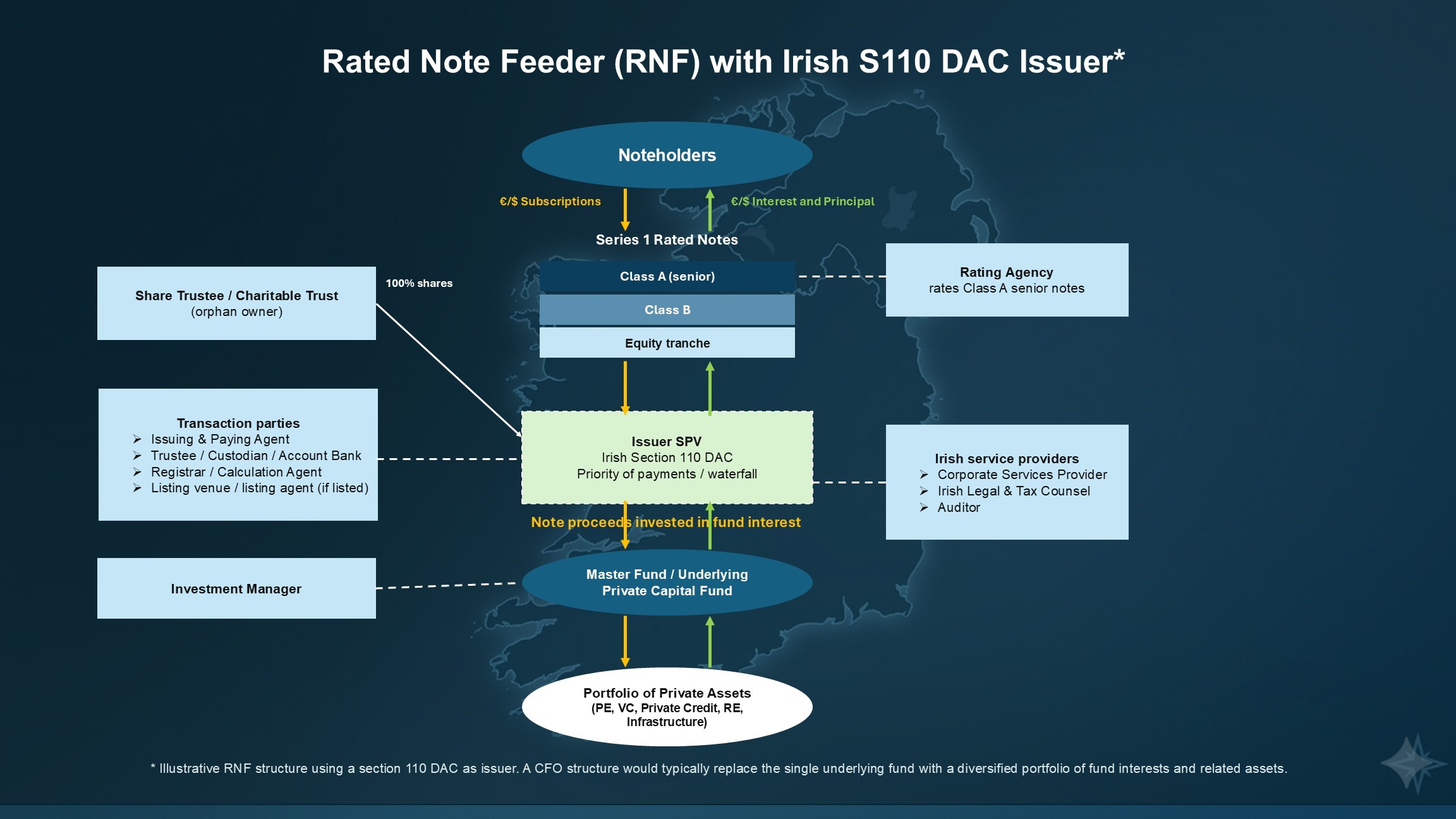
An Irish s110 DAC as Issuer
An Irish Section 110 company is established to qualify for Ireland’s securitisation regime under Section 110 of the Taxes Consolidation Act 1997 (TCA). If the rules set out in Section 110 are properly followed, the company should incur minimal tax leakage at the vehicle level. Positive attributes include:
- A qualifying company may deduct most of its expenses, including interest and profit participating coupons, subject to conditions, on the notes it issues, so tax in the vehicle can be kept at a negligible level.
- No Irish stamp duty should arise on the issue or transfer of the notes where the notes are used to fund the company’s business.
- A VAT exemption applies to many services provided to Section 110 companies.
- Section 110 companies are generally entitled to access Ireland's double tax treaty network.
- Vehicles established solely to engage in structured finance transactions generally do not require Central Bank of Ireland authorisation.
- Section 110 companies, which are incorporated as a DAC, can be incorporated within five business days, and often less, with a minimum issued share capital of €1.
- There is a broad range of withholding tax exemptions available for interest paid on debt securities issued by a Section 110 company, or other Irish company. This includes broad exemptions for interest paid to residents of EU Member States or Irish treaty countries and a specific exemption for certain listed debt securities, referred to as the quoted Eurobond exemption.
There are certain qualifying conditions to be met to qualify for Ireland’s securitisation regime under Section 110 TCA. Among them, a Section 110 company may only hold certain ‘qualifying assets’ which include a broad range of financial assets such as shares, debt instruments, and derivatives. The first qualifying assets acquired by the company must have a total value of at least €10 million on day one, and the Section 110 company must notify the Revenue Commissioners within eight weeks of that first acquisition. The qualifying conditions should be discussed at the outset of a transaction to ensure they are met.
Regulatory Considerations - Is It a Securitisation?
The definition of ‘securitisation’ in the EU Securitisation Regulation is broadly drafted. It refers to a transaction or scheme where the credit risk associated with an exposure or pool of exposures is tranched, payments depend on the performance of that exposure or pool, subordination determines the distribution of losses during the life of the transaction, and the specialised lending exclusion is not available. This means that a range of transactions can fall within scope, even where that was not the intention of the parties.
Legal analysis of the proposed structure is necessary to determine whether the EU Securitisation Regulation is engaged by the structure. It can also be engaged by the investor and/or another transaction party depending on their regulatory status and location. In the case of RNFs and CFOs, where the risk associated with the investment in the underlying funds is tranched, the analysis will be fact-specific and may ultimately turn on whether the interest in the underlying fund is properly characterised as credit risk. Where the regime applies to an RNF or CFO, the relevant parties must comply with applicable requirements, including due diligence, risk retention, transparency, and credit-granting criteria.
It is also worth noting that the EU securitisation regulatory regime is currently undergoing reform. The European Commission tabled proposals in June 2025 to simplify the framework and make it more proportionate. Trilogues on the proposed amendments to the EU Securitisation Regulation and the Capital Requirements Regulation recently ended under the Irish Council Presidency, with provisional political agreement announced in October 2026. Expected changes include new definitions of ‘public’ and ‘private’ securitisation, targeted updates to due diligence and risk retention requirements, and new, simplified reporting templates for private securitisations. Changes impacting prudential capital requirements, strengthening the ‘STS’ label, and increasing investment limits for UCITS are also anticipated. Final legal texts are awaited with provisions expected to apply from mid-2027 at the earliest.
Insurers should also note that from 30 January 2027, changes to the Solvency II rules[4] will reduce the standard-formula spread risk charge for certain eligible senior securitisation positions, subject to the applicable classification and eligibility analysis.
Comment
For managers considering establishing a first RNF or CFO in the European market, the practical question is not whether Ireland works, but how early the Irish workstreams begin. Proactive and early groundwork on the Irish elements will be rewarded, considering that:
- Capital treatment could improve from January 2027 under Solvency II amendments. Subject to legal analysis, structures being scoped this year could be marketed into a more favourable regime.
- The Section 110 qualifying conditions are easier to accommodate at structuring stage. In this regard, requirements around ‘qualifying assets’ and the €10 million day-one test are straightforward when planned proactively.
- Managers may wish to position themselves for repeat issuances and build out a platform. This can be achieved by setting up a multi-series programme, allowing later issuances to be completed more quickly and cost-effectively than establishing a new vehicle each time. If this route is taken, early engagement with the rating agencies is key.
Overall, using an Irish s110 DAC to issue rated debt in CFO and RNF structures is a compelling proposition for managers and investors. Our Structured Finance, Fund Finance and Tax teams have extensive experience advising on a range of structured finance, securitisation and fund financing structures, acting for a wide range of financial institutions and capital markets participants. We work together cohesively to provide clients with the benefits of a cost-effective and streamlined process.
[1] KBRA Private Credit: 2026 Outlook
[2] Sources: Central Bank of Ireland, Quarterly Special Purpose Entities Statistics, Q2 2026 (September 2026); European Central Bank Data Portal, Assets and liabilities of euro area financial vehicle corporations (FVCs), Q2 2026; Irish Debt Securities Association (IDSA), Industry Statistics – Facts & Figures (Q2 2026); Atlantic Star Analytics, Irish SPV Report Q2: 2026
[3] Sources: Central Bank of Ireland, Investment Fund Statistics, Q2 2026; Irish Funds, Irish Domiciled Funds, Total net Assets & No. of Funds; Irish Funds, Ireland Captures 58% of European Fund Net Inflows in First Half of 2026, 15 October 2026
[4] Introduced by Commission Delegated Regulation (EU) 2026/269 of 29 October 2025