




NAV facilities come in all shapes and sizes and, unlike subscription facilities, there is no standardised collateral package for these kinds of transactions. In the European market, many lenders - particularly investment banks - are focused on ensuring that they have recourse to the underlying assets of the fund via their security documents. This might take the form of direct security over: (i) each of the topcos through which a fund (indirectly) owns the relevant underlying portfolio company; (ii) any aggregator vehicle through which the fund (indirectly) owns all or a large number of the underlying portfolio companies; or (iii) a combination of (i) and (ii). Recently, we have seen an uptick in the number of financings in Europe that are structured as what are commonly referred to as “security-lite” transactions: these transactions involve no security being granted over the underlying assets of the fund, with lenders (often non-bank in this context) only given secured recourse to the bank accounts into which distributions from the fund’s investments are paid. In this article, we shine a light on some of the key factors to take into account for these kinds of transactions.
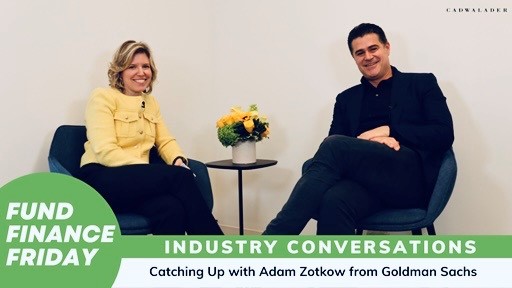
Join partner Leah Edelboim as she sits down with Adam Zotkow from Goldman Sachs for a captivating Industry Conversation.

Join Women in Fund Finance for Wine-d Down Wednesday at Fotografiska Museum NYC, where you can connect over world-class photography and wine!
“Increasing allocations will come down to cash flows,” according to Bain & Co. in its recent Global Private Equity Report 2024. The practical impact of net cash flow position for buyout fund investors, reflected in DPI, will be a primary driver of fundraising in 2024.
CalPERS will be upping its private market allocation to 40% of plan assets, after a board decision on March 18. PE will increase to 17% from 13 and private debt to 8% from 5% of plan assets.
Blackstone’s purchase of $1.1 billion in credit card receivables from Barclays and KKR’s acquisition of a $7.2 billion RV loan portfolio from Bank of Montreal illustrate a trend of private credit expansion into asset-backed finance. Continued balance sheet pressure at banks suggests more such transactions may be coming.
Texas Permanent School Fund announced that it will replace BlackRock as manager on $8.5 billion of investments.


Our readers have been blessed with wonderful Fund Finance Friday articles dealing with the maintenance of collateral accounts in 'When Deposits Don’t Travel with Loans', control over collateral accounts in 'Control or Control Agreement' and lastly, events of default in 'Common Events of Default in Subscription Credit Facilities: How Parties End Up Here, and Recommendations for Avoiding Preventable EODs'. In this article we explore the circumstances under which lender may take action with respect to collateral accounts, often called Cash Control Events.
On February 7 2024, the European Union adopted a final text amending the AIFMD and UCITS directives (AIFMD II). In a recent Client & Friends Memo authored by Michael Newell and Alix Prentice, we focus on loan origination funds and the novel rules applying to them in terms of scope, leverage requirements and liquidity management requirements, as well as important considerations for the grandfathering period as these entirely new rules come into force locally across Europe.
Read more here.
The Drawdown has named Cadwalader among its finalists for excellence and innovation within private fund operations!

The Fund Finance Series Webinar held on February 15th organised by the Luxembourg law firm Praxio Law & Tax and hosted by Michael Mbayi on the topic “2024 Market Perspectives” is now available and includes insights from Cadwalader's own, Michael Hubbard!

The Fund Finance Association NextGen team invites you to join us for an evening of networking!