



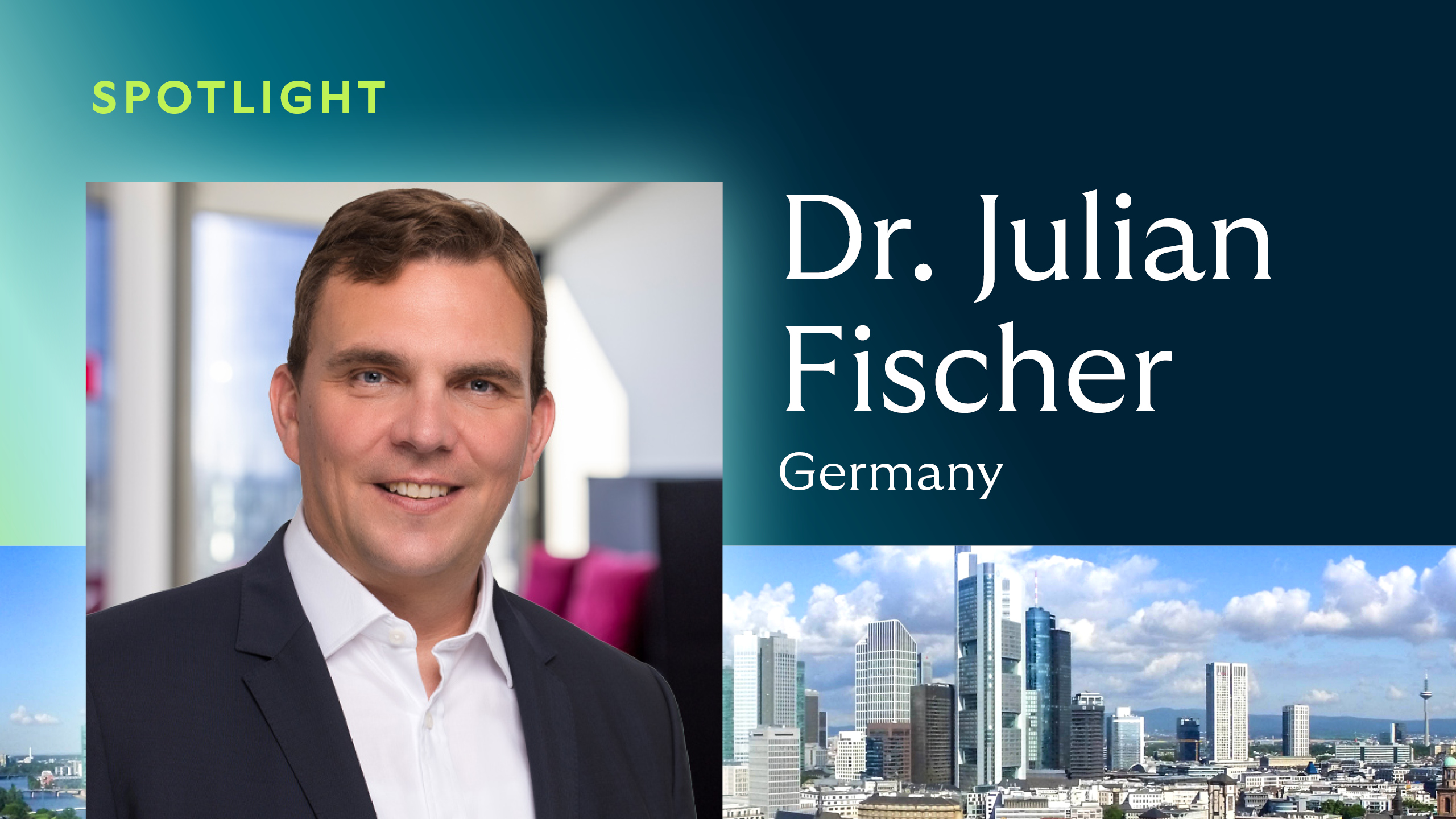
Welcome to this week's Spotlight, where we'd like to introduce you to Dr. Julian Fischer, a partner in our Frankfurt office. Julian has more than 20 years of experience in structured finance and fund structures and possesses deep knowledge at the interfaces of financial, capital market, and financial supervisory law. Julian has experience advising on loan and derivatives portfolio sales, agency and trust functions, securitisation and refinancing of credit, mezzanine, and profit participation certificate portfolios.
Let's get to know Julian, his practice, and his region.
What first attracted you to finance, and how has your practice grown and diversified during your time at the firm?
I was drawn to finance law early in my career by the intellectual complexity of structured transactions and the way they sit at the intersection of regulatory, corporate, and capital markets law. Over the years, my practice has grown from traditional bank lending into a much broader spectrum – covering debt capital markets, fund finance, NPL and sub-performing loan portfolio transactions, and regulatory advisory work. At the firm, I have had the opportunity to build a truly cross-disciplinary practice, advising both lenders and borrowers on financing and restructuring matters while also advising on the structuring and distribution of investment funds across Germany and Europe.
How would you characterize the current state of the fund finance market in Germany and what notable trends are you observing?
The German fund finance market, one of Europe’s largest and most dynamic, continues to mature and diversify. The ongoing transformation of the German banking sector – driven by consolidation, regulatory capital optimization, and the rise of alternative lenders – has created fertile ground for fund finance and related credit transactions. We are also seeing European fund managers increasingly choosing German and Luxembourg structures for their vehicles, which generates cross-border advisory demand on both the structuring and distribution side.
Against this backdrop, several notable trends are emerging. We see increased activity from alternative lenders – debt funds and insurance companies – stepping into spaces traditionally occupied by banks. At the same time, regulatory developments such as the evolving securitization framework and increasing regulatory capital requirements for non-securitized loan assets are reshaping transaction structures. Portfolio transactions involving non-performing and sub-performing loans remain active as banks pursue deleveraging strategies, creating significant deal flow on the secondary market.
What can you share about your capabilities in the region?
Our team advises on the full lifecycle of fund finance and debt capital markets transactions – from origination and structuring through to secondary market sales, restructuring, and regulatory compliance. We act for public and private banks, insurance companies, debt funds, alternative credit providers, and institutional borrowers across a wide range of sectors. Our capabilities extend to investment fund structuring and distribution, including all regulatory and tax aspects, as well as financial market stabilization measures and complex portfolio transactions involving distressed and sub-performing assets.
How has the focus of your practice shifted over the past year?
Over the past year, there has been a notable increase in cross-border portfolio transactions and secondary market activity, which has occupied a larger share of my practice. I have also seen growing demand for regulatory advisory work, particularly around fund structuring and distribution in the context of tightening European supervisory expectations. Restructuring mandates have picked up as well, reflecting broader macroeconomic pressures on certain borrower segments.
Where do you see the most potential for growth in fund finance over the next few years, and what forces will drive that growth?
I see considerable growth potential in NAV-based and hybrid financing structures as funds seek more flexible leverage solutions. The continued expansion of private credit in Europe will also be a major driver, with institutional investors increasingly channelling capital through debt funds. Regulatory pressure on traditional banks to manage risk-weighted assets will sustain demand for credit portfolio sales and risk transfer mechanisms. Additionally, the growing financing needs in the infrastructure and energy sectors will create new product opportunities across the fund finance landscape.
What are some noteworthy deals you’ve been involved with over the past year?
In one deal, we advised an investment firm on the establishment of a securitized debt fund structure. The mandate included, in particular, the structuring and establishment of the alternative investment fund (including the preparation of the relevant fund documentation), as well as the establishment of a securitization vehicle acting as (one of) the investor(s) in the fund and issuing fund-linked notes to institutional investors. The advice further covered the preparation and negotiation of the related transaction and note documentation, prospectus approval process, listing, as well as regulatory advice both at the fund level and the investor level.
In a separate transaction, we advised several institutional investors in connection with their investment in fund-linked notes. The mandate included, in particular, advising on and preparing noteholders' meetings (Gläubigerversammlungen) for the purpose of restructuring/prolonging the term of the notes as well as requesting additional measures to be taken by the issuer, in its capacity as investor in the reference fund, regarding its investment in the reference fund.
Let's wrap up with a personal question. What book, movie, or TV show would you most recommend to others?
I would recommend The Big Short by Michael Lewis – it remains a brilliant and highly readable account of the dynamics that can build up in credit markets, and it serves as a useful reminder of why the legal and structural safeguards we build into transactions matter so much.