




For years, Asian fund finance followed a familiar playbook. Private equity, venture capital and real asset managers in Singapore and Hong Kong typically raised capital through offshore vehicles, most commonly Cayman Islands Exempted Limited Partnerships (ELPs). Subscription line lending, security packages and credit analysis were therefore built around Cayman legal concepts, Cayman perfection mechanics and Cayman governance norms.
That model is changing.
Substance rules, tax efficiency and targeted government policy have pushed fund formation closer to where managers, investment teams and assets are based. Singapore’s Variable Capital Company (VCC), launched in 2020, and Hong Kong’s Limited Partnership Fund (HKLP) regime, introduced the same year, have accelerated that shift and given Asian sponsors credible domestic alternatives to legacy offshore structures.
For lenders, this is not a cosmetic change. As GPs increasingly domicile funds alongside their operations in Singapore and Hong Kong, credit committees must recalibrate the way they assess borrower structure, collateral, account control and enforcement. The rise of VCCs and HKLPs is reshaping the credit architecture of Asian fund finance.
Part I: The Anatomy of Onshore Vehicles
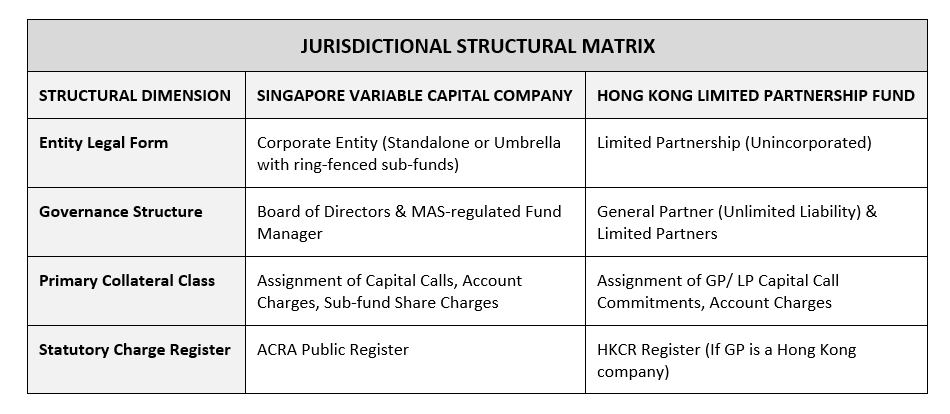
The starting point is structural. Singapore’s VCC is a corporate fund vehicle. Hong Kong’s HKLP is a partnership. That distinction drives very different credit, collateral and enforcement outcomes.
1. The Singapore Variable Capital Company (VCC)
The VCC is purpose-built for investment funds. It may operate as a standalone fund or as an umbrella fund with multiple segregated sub-funds, each with its own assets and liabilities.
For fund finance, the umbrella VCC is powerful but precise. The parent is one legal entity, yet each sub-fund is an economically ring-fenced pool. That gives lenders flexibility to finance individual sub-funds, but only if the documents tightly preserve segregation and avoid unintended cross-liability between sub-funds.
2. The Hong Kong Limited Partnership Fund (HKLP)
The HKLP follows a more familiar partnership model. It has no separate legal personality. The General Partner (GP) manages the fund and bears unlimited liability, while Limited Partners (LPs) retain limited liability so long as they stay out of day-to-day management. This familiarity has allowed lenders to adapt Cayman-style subscription line documentation quickly, while benefiting from local Hong Kong law perfection and enforcement.
Part II: Rewriting the Credit Underwrite
VCCs and HKLPs require lenders to move beyond offshore templates. Risk teams now need to underwrite domestic statutes, local regulatory oversight and practical operating risks, not just investor credit quality.
1. Underwriting the Singapore VCC: Ring-Fencing and Share Redemptions
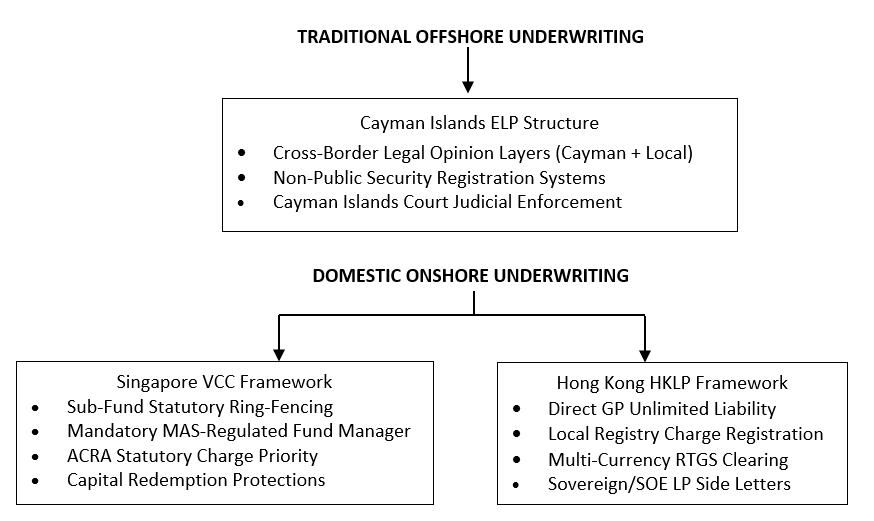
For an umbrella VCC, underwriting starts with the statutory ring-fencing regime under section 29 of the VCC Act.
- Asset-Liability Segregation Risk: Singapore law prevents the assets of one sub-fund from being used to meet the liabilities of another. A lender financing Sub-Fund A must therefore ensure the facility documents do not create accidental cross-collateralisation or cross-default exposure across unrelated sub-funds. If the statutory ring-fence is compromised, enforceability may be at risk.
- Control of Equity Capital Redemptions: A VCC may redeem shares and pay dividends out of capital without shareholder or court approval. That flexibility is useful for funds, but it can erode the credit base. Subscription line documents should restrict redemptions, capital returns and similar leakage while the facility is outstanding, and especially after default.
- Regulatory Footprint as Credit Support: A VCC must appoint a local Fund Manager regulated by the Monetary Authority of Singapore (MAS). For lenders, that onshore regulatory nexus is a meaningful credit positive. It improves oversight and reduces AML, operational and governance risk compared with lightly regulated offshore structures.
2. Underwriting the Hong Kong HKLP: GP Standing and Regional LPs
For an HKLP, the focus shifts to the GP’s statutory position and the fund’s investor base, similar in terms of considerations as with an ELP.
- General Partner Unlimited Liability: The GP is fully liable for the obligations of an HKLP. Lenders should look closely at the GP’s capitalisation, operating history, balance sheet and ownership chain. If the GP is a thinly capitalised SPV as is sometimes the case with Asian GP setups, parent support or direct recourse to the sponsor platform will need to be considered.
- RMB Controls and Cross-Border LP Review: HKLPs often attract Mainland Chinese institutions, sovereign investors and state-owned enterprises. Investor diligence therefore becomes critical. Lenders should review commitment letters and side letters for currency transfer restrictions, regulatory approvals and potential cross border remittance bottlenecks resulting from foreign exchange controls that may delay or impair capital calls.
Part III: Deal Structuring, Collateral Perfection, and Cash Control
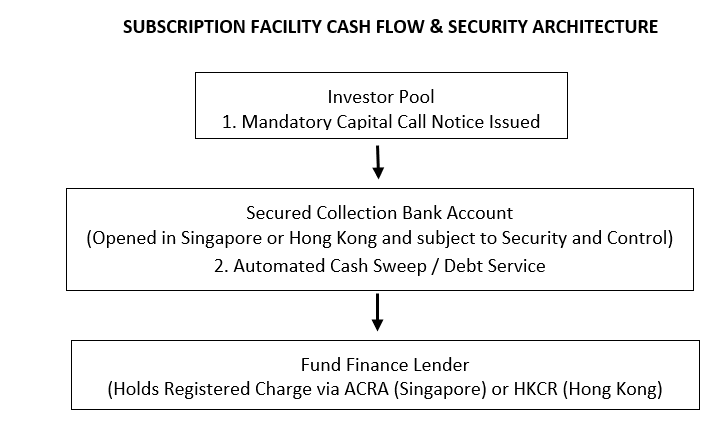
Subscription line collateral still turns on two essentials: the assignment of capital call rights and control over the accounts into which LP proceeds are paid. What changes is how that package is perfected, controlled and enforced under domestic law.
1. Perfection Mechanics: Public Registration vs. Notice Delivery
One clear advantage of the domestic regimes is visibility. Perfection and priority are anchored in local legal processes rather than split across offshore and onshore systems.
- Singapore VCC Charge Registration: Security granted by a VCC over its assets (including uncalled capital commitments, bank accounts and sub-fund interests) must be registered with the Accounting and Corporate Regulatory Authority (ACRA) within 30 days of creation, or 37 days if executed outside Singapore. Registration gives lenders priority vis-à-vis unregistered security interests. Missing the deadline risks the security being void against a liquidator or competing creditor.
- Hong Kong HKLP Security Perfection: For an HKLP, the assignment of capital call rights is perfected under Hong Kong contract and property law by giving formal written notice to LPs. If the GP is a Hong Kong private company, the relevant charge must also be registered with the Hong Kong Companies Registry (HKCR) within one month of execution (or if the instrument is executed outside of Hong Kong, within one month of that the instrument could have arrived in Hong Kong by post). The latter stirred up issues during the Covid lockdown. Suffice it to say that the HKCR is unsympathetic to tardiness and prompt registration is imperative to avoid the high costs of rectification. Likewise, public registration ensures priority vis-à-vis unregistered security interests and avoids issues associated with insolvency and competing interests.
The latter stirred up quite a bit of issues during the Covid lockdown when instruments had to be executed in whole or part outside of Hong Kong and delivered to Hong Kong for registration. Suffice it to say that the HKCR is unsympathetic to tardiness and prompt registration is imperative to avoid the high costs of rectification.
2. Cash Management Architecture
Account control is paramount. Lenders need to trap LP proceeds, stop leakage and take control after default. Some critical points to note when navigating account structures are set out below.
- Sub-Fund Account Isolation in Singapore: Umbrella VCC accounts should be opened in the name of the specific borrowing sub-fund, such as “Alpha Asia VCC - Sub-Fund I”. Account control agreements or deeds of charge should give the lender control on default and prevent LP proceeds from being mixed with cash belonging to other sub-funds.
- Multi-Currency RTGS Clearing in Hong Kong: HKLP facilities often support USD, HKD, CNH and EUR drawdowns. Linking account security to Hong Kong’s Real Time Gross Settlement (RTGS) infrastructure gives lenders faster control over funds and reduces the administrative friction that can arise in cross-border funds transfers.
3. Execution Streamlining and Efficiencies in Enforcement
Domestic vehicles also simplify execution. Fewer jurisdictions mean fewer opinions, fewer hand-offs and a clearer enforcement route.
- Elimination of Offshore Counsel Layers: Cayman structures typically require offshore and onshore legal opinions. VCC and HKLP facilities can often be documented and opined on under local law. The result is a shorter closing process, lower legal spend and fewer execution dependencies.
- Direct Judicial Enforcement: If an LP fails to fund a capital call, lenders can enforce through the High Court of Singapore or the High Court of Hong Kong, both dispute avenues well known for their high levels of efficiency. The more direct route of enforcement avoids the cost and uncertainty of offshore recognition proceedings and gives lenders a more predictable path to recover LP drawdown proceeds. Asian subscription lines with VCC and HKLP structures are trending towards the adoption of local laws and local disputes resolution forums.
Concluding Thoughts
Singapore VCCs and Hong Kong HKLPs are no longer just fund formation tools. They are reshaping how Asian subscription finance is structured, secured and enforced.
With local registration, direct court access and tighter cash control, these vehicles offer a cleaner path for sponsors and stronger protection for lenders.